
Thy Kingdom Come: The Invasion. Part 2 of 3

The throne was taken. But the throne room did not simply fill with the enthroned Christ and close its doors.
It deployed.
Fifty days after the resurrection. Ten days after the ascension. A hundred and twenty people in an upper room in Jerusalem. Waiting for something Jesus promised but had not described in detail.
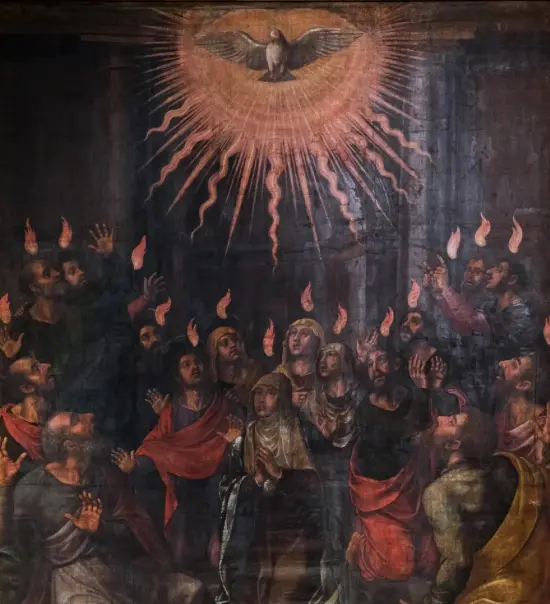
And then... the sound of a mighty rushing wind filling the entire house. Tongues of fire distributed and resting on each one. All of them filled with the Holy Spirit and speaking in languages they had never learned.
The invasion had begun.
But to understand what Pentecost actually was we need to stand in a valley with Ezekiel first.
Six hundred years before the upper room God set Ezekiel down in a valley full of very dry bones. Not a recent battlefield of blood and gore. Bones bleached by the sun and stripped of everything. The most irreversible form of death.
Can these bones live?
The honest answer is no. And Ezekiel (to his eternal credit) gives the most theologically precise answer available: O Lord God, you know.
God tells him to prophesy to the bones. To speak into the valley of death. And there is a sound, a rattling, bone coming to bone, sinew and flesh appearing, skin covering them. But there's no breath. The bodies assembled and the structure present. It's death wearing the appearance of life.
God says prophesy again. This time to the breath. Come from the four winds. Breathe on these slain that they may live.
The breath comes. From the four corners of the earth. And a vast army stands on its feet.
God tells Ezekiel what it means. The bones are Israel, exiled, cut off, saying our hope is lost. And God’s word to the dried bones of a scattered and hopeless people is:
I will put my Spirit within you, and you shall live. (Ezekiel 37:14)
My Spirit within you. Not among you. Within you. The indwelling presence of the Spirit of God as the source of life for a people reduced to dry bones.
Five hundred years later Joel sharpens the promise:
I will pour out my Spirit on all flesh; your sons and your daughters shall prophesy, your old men shall dream dreams, and your young men shall see visions. Even upon the male and female servants in those days I will pour out my Spirit. (Joel 2:28–29)
All flesh.
Not just the kings and the high priests. Not the specially anointed few who received the Spirit for specific tasks. All flesh. Sons and daughters, old men and young men, male and female servants. Those of the lowest social tier, the ones the powerful had no use for except as labor.
This is the announcement that the gods of the nations had failed and something entirely different was coming. Not a better hierarchy. But the end of the hierarchy. The Spirit going all the way to the bottom.
And then Acts 2.
The sound like a mighty rushing wind, the same breath Ezekiel called from the four winds. Tongues of fire resting on each one, not on one leader, on each one. Exactly as Joel said.
And they begin to speak in the languages of every nation under heaven.
Parthians and Medes and Elamites. Mesopotamia and Judea and Cappadocia. Egypt and Libya and Rome. Cretans and Arabians. Every nation. Every language. Every territory the gods of the nations had been assigned to govern.
The Spirit is not respecting the territorial boundaries of the divine council. The Spirit is going everywhere the gods of the nations had claimed as their domain. The languages of the nations, the very marker of the divine council’s division of humanity at Babel, are being reclaimed. The Spirit is reversing Babel. What was divided is being unified not by one language but by one Spirit speaking through all languages simultaneously.
Peter stands up and quotes Joel. Because he understands for the first time what Joel was actually describing. And he lands the sermon with the widest possible invitation:
Everyone who calls on the name of the Lord shall be saved. (Acts 2:21)
Everyone. As wide as all flesh. As wide as the four winds. As wide as the valley of dry bones.
Here is what the powers miscalculated. They thought the death of Jesus ended the movement. They understood power as concentration, as hierarchy, as the flow of authority from the top down through selected and controllable channels. That was the system they operated.
And the Spirit bypassed the entire system.
Poured out on all flesh. Going to the bottom. To the servants. To the daughters. To the old men the world had finished with. To the dry bones the powers had decided were beyond the possibility of life.
You can’t stop a breath. You can’t block a wind. You can’t keep the Spirit out of the territory you thought you controlled.
The ascension took the throne. Pentecost deployed the presence.
And the territory the powers thought they still controlled would never be the same.
Part 3: The Embassy... next week
Joan de Joanes (Valencia, c. 1505 - Bocairent, 1579), Pentecost, Oil on serge.


Comments