
The impossible object and an impossible Gospel
- Justin Scoggins, Th.D.

- Apr 21
- 5 min read
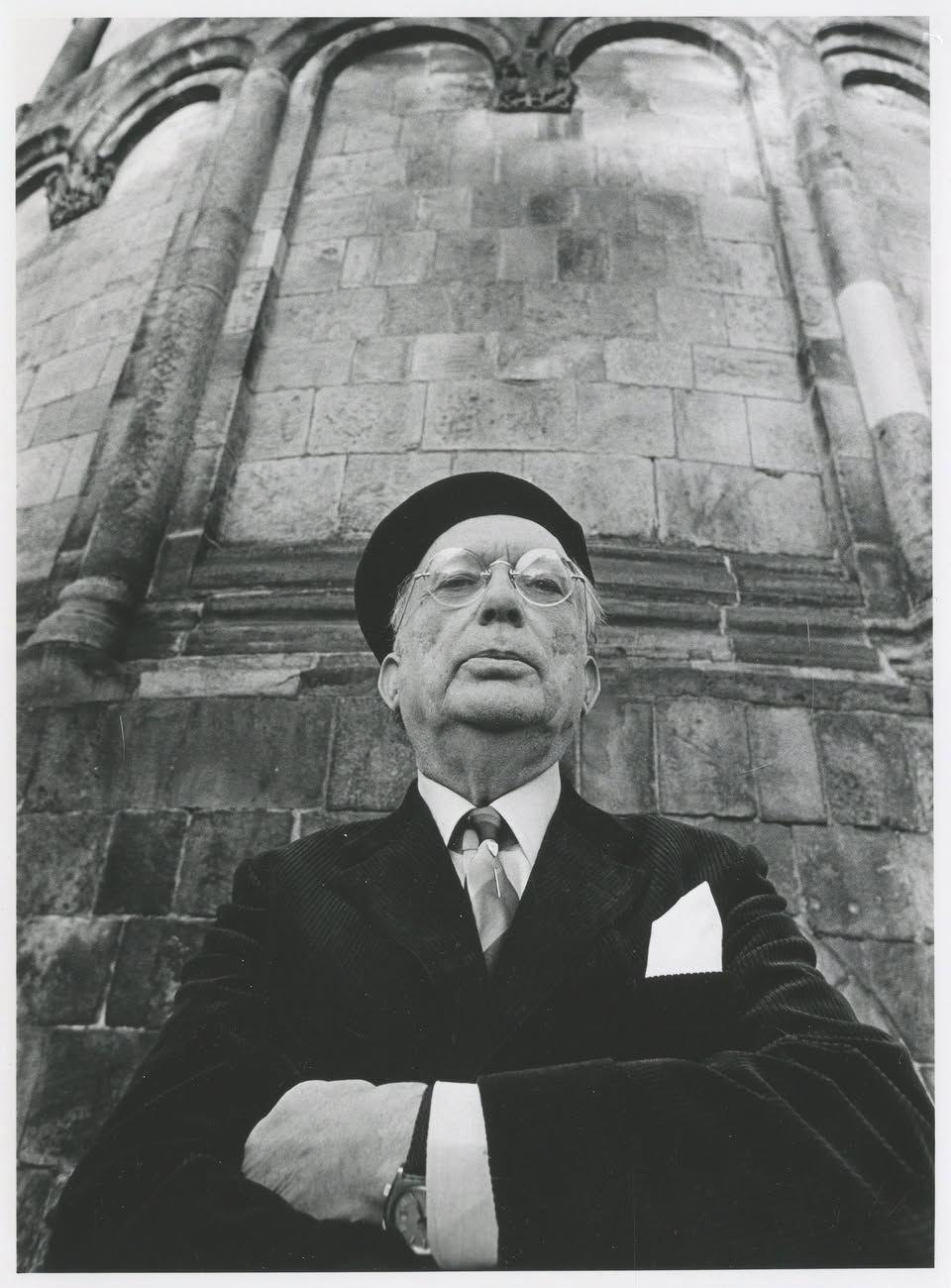
Oscar Reutersvärd is one of my personal hero’s. You’ve probably never heard of him, and that’s okay. But he has impacted my theology, how I approach scripture, and even to how I pastor.
He was the guy behind impossible figures, the creator of things you might call outright insane before realizing his paintings are a gateway to a deeper truth. The "father of the impossible figure," Reutersvärd sketched his first three-pronged Penrose Triangle in 1934, taking artistic geometry to a level few could anticipate.
His works were not just about tricking the eyes for amusement; I think it was more a testament to human potential and creativity, boldly standing as a challenge against the monotony of the culture around him. He was, I figure, the anti-establishment artist before it became trendy in art schools to scoff at tradition just for kicks. While leftists plaster themselves over clichéd contemporary art and performative pieces that mean precisely nothing, Reutersvärd created something different. He created something deeply rooted in imagination, poking the intellect, and all with genuine skill.
Oscar’s work tells me one thing: boundaries are there to be challenged, but they should be challenged with skill, grace, and intellect, not just with rebellious disrespect. It’s easy to slap some paint on a canvas and call it a paradigm shift, its not as easy to dedicate one's skills to crafting enigmas that invite contemplation and exploration.
What Oscar Reutersvärd stood for is timeless and transcends petty squabbles of left versus right in the cultural domain. His works whisper stories and ideals that speak louder than any political rhetoric. The idea of the impossible invites curiosity and wonder, much like the world we're in. Because the truth is we are in a world where the absolutes and certainties are often just constructs.
Enter the gospel, and this is what I love. Jesus and his kingdom are impossible, when you look at it on paper. It just doesn’t make sense. The first shall be last. The least will be greatest. You have to die to live. Give up everything to gain everything. Paradoxes around every corner.
Oscar Reutersvärd understood something most of us forget: what looks impossible often isn’t a failure of reality, but a failure of perspective. His figures don’t break the rules as much as they expose how limited our vantage point might be. Scripture says something similar long before modern art ever tried to, but it echos in its own way.
“My thoughts are not your thoughts, neither are your ways my ways, declares the Lord” (Isaiah 55:8).
This is an invitation to look again. Look at the shaping and form. Even in the obscurity.
Jesus announces a kingdom that immediately feels off. Blessed are the poor in spirit. Blessed are the meek. Blessed are the persecuted. These are not virtues in any empire we recognize. And yet Jesus doesn’t hedge or explain himself. He simply declares, “For theirs is the kingdom of heaven” (Matthew 5:3). The lines have already started bending. And none of it makes sense.
Then comes the inversion that sounds like a mistake unless you slow down long enough to stare at it and let it stare back at you:
“So the last will be first, and the first last” (Matthew 20:16).
This more structural than poetic. The kingdom is drawn differently. Power does not accumulate upward; it goes down. Greatness is not seized; it is given and received. When the disciples argue about who is the greatest, Jesus doesn’t correct their motives, he reframes the thought:
“Whoever would be great among you must be your servant… even as the Son of Man came not to be served but to serve, and to give his life as a ransom for many” (Matthew 20:26–28).
That’s the moment you realize you’re staring at an impossible figure. Jesus doesn’t climb the ladder, that’s too easy. He becomes the ladder. And his authority flows through self-giving love, not self-preserving ambition.
And Jesus presses it even further:
“If anyone would come after me, let him deny himself and take up his cross and follow me. For whoever would save his life will lose it, but whoever loses his life for my sake will find it” (Matthew 16:24–25).
Lose to win. Die to live. Empty to be filled. Paradoxes compounding into the impossible.
Paul later names what the early church already experienced as disorientation:
“The word of the cross is folly to those who are perishing, but to us who are being saved it is the power of God” (1 Corinthians 1:18).
From one angle, the cross is failure. From another, it is the hinge of history. Paul leans into this paradox…this impossibility:
“God chose what is foolish in the world to shame the wise; God chose what is weak in the world to shame the strong” (1 Corinthians 1:27).
This is not God playing games, it’s just God revealing the limits of human wisdom. The gospel is an impossible object not because it’s incoherent, but because it refuses to flatter our instincts and that was makes it so cool. That’s the draw. The hook.
Philippians 2 may be the cleanest rendering of the whole illusion:
“Though he was in the form of God,
he did not count equality with God a thing to be grasped,
but emptied himself…
he humbled himself by becoming obedient to the point of death, even death on a cross.
Therefore God has highly exalted him” (Philippians 2:6–9).
Down becomes up. Humiliation becomes exaltation. The lowest point becomes the highest name. The resurrection doesn’t correct the cross; it only confirms that this was the shape of glory all along. And this is where the metaphor finally lands on us.
The kingdom of God cannot be built with the tools that built every other kingdom. Jesus says it plainly:
“My kingdom is not of this world” (John 18:36).
Which means pastors, churches, and Christians are constantly tempted to redraw the lines so they make more sense. We try to straighten what Jesus intentionally bent trying to make a gospel that works, that climbs, and that wins. But the moment it becomes entirely reasonable, it stops being the gospel.
The impossible gospel still stands. Like Reutersvärd’s figures, it refuses to collapse even though every rule says it should. It holds because God is faithful, not because we’ve got the shape or form figured out. And the invitation is not to solve it; but to become impossible ourselves.
“Let the one who has eyes to see, see” (Mark 8:18).
Because the kingdom isn’t just about believing in the impossible, it’s about allowing that impossibility to shape and form us. And that, my friends, is super cool.


Comments